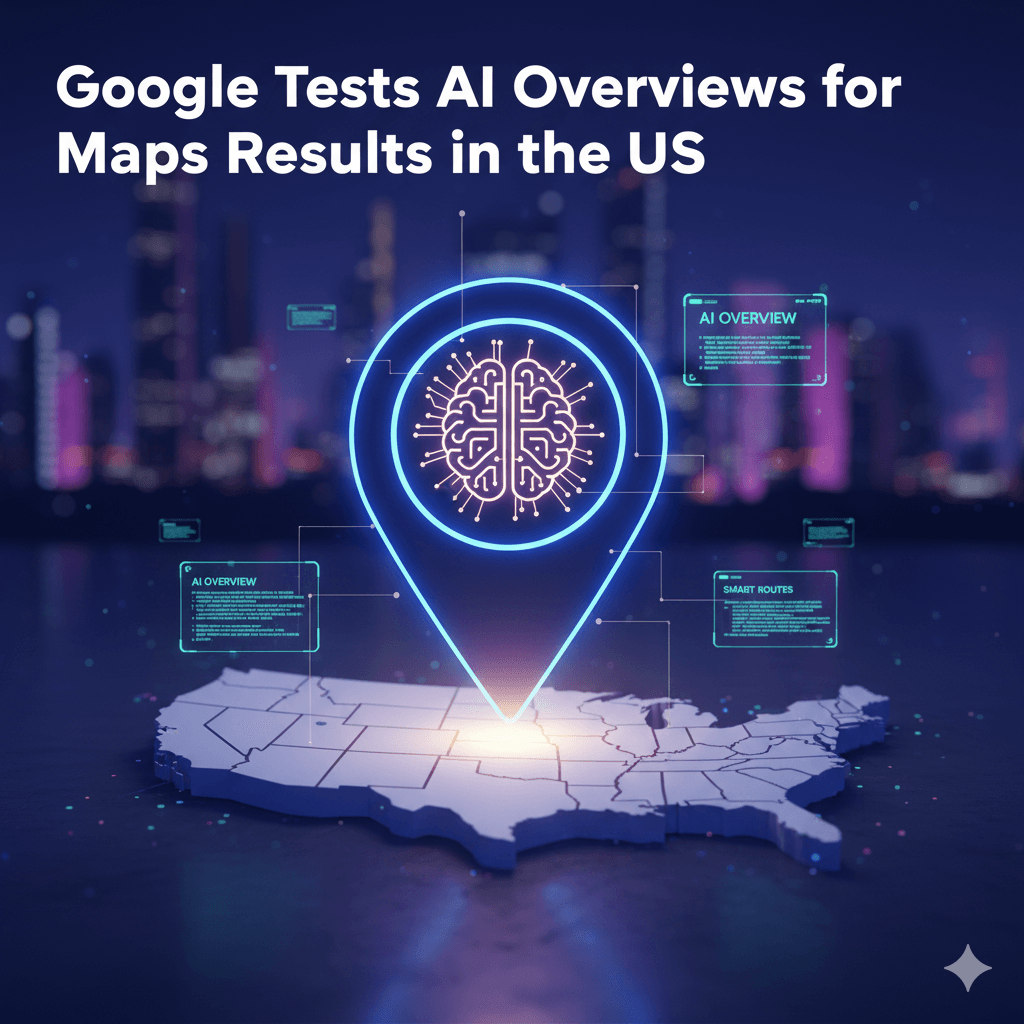
In the midst of a rapidly evolving digital landscape, Google’s recent move to replace its longstanding Maps local pack with AI-generated overviews marks the most fundamental change in local search results in over a decade.
This bold experiment, currently limited to “near me” searches in the United States, underlines Google’s ambition to place generative AI Overviews and conversational search at the heart of user experience. Where once users saw a familiar list of map pins and local listings, they’re now met by concise, context-rich AI-generated summaries built by the powerful Gemini 2.0 LLM, shaking up everything from visibility to user trust.
This is not just a surface-level update, but the culmination of years of AI strategy and careful product iteration across Google’s ecosystem. For businesses and SEOs globally, especially those in countries like Australia who keep a close eye on US search innovations, these changes signal a future where AI Mode may dramatically reframe how customers find local services, products, and information.
In short
- Google is testing the removal of the Maps local pack for “near me” searches in the US, replaced by AI Overviews generated by Gemini 2.0.
- AI Mode, with its conversational, multimodal, and context-driven answers, moves beyond the traditional 10 blue links, reflecting a major shift in search design and user expectations.
- These AI Overviews synthesize multiple data sources, offering faster, direct answers but raising concerns over transparency, source trust, and local discoverability.
- The AI Mode experiment is ongoing and opt-in only for now in the US, but signals a broader ambition to expand globally and transform what appears on the first page of Google.
- SEOs, local businesses, and content publishers must rethink strategies, focusing on authoritative, unique, and structured data to remain visible in AI Overviews-dominated search results.
Google Maps Local Pack Replaced by AI Overviews: A Major US Search Experiment
For years, the Maps local pack was the anchor of local intent queries like “restaurants near me,” surfacing map pins, business listings, user reviews, and photos. In a dramatic pivot, Google has started an experiment in the United States by removing the classic local pack for many “near me” searches and introducing AI Overviews instead.
These AI-powered summaries now attempt to answer local queries directly with synthesized information from across the web, Google Maps, and other data sources.
The transformation is underpinned by Google’s Gemini 2.0 LLM. By shifting from 10 blue links and static packs to dynamic, context-driven answers, Google aims to connect users more efficiently with relevant local data.
For instance, a fictional local business, let’s call it “Harbor Street Cafe”, may now see its appearance in search results replaced by an AI summary highlighting its hours, unique features, and recent customer sentiment, aggregated from review sites and contextualized within current local trends.
Instead of simply listing addresses, AI Overviews could suggest, “Harbor Street Cafe is popular for brunch, offers vegan pastries, and is typically busiest on weekends around 10 am.”
| Feature | Traditional Maps Pack | AI Overviews |
|---|---|---|
| Displayed Content | Map, list of 3-5 local businesses, direct links | Summarized local info, links to sources, follow-up prompts |
| User Journey | Click & explore each result | Direct answer; conversational refinement |
| SEO Impact | Local pack optimization crucial | Prioritizing source authority, structured data |
- User intent remains central, but the way local businesses can appear in search results is now mediated by AI synthesis, not just by map optimization.
- For Google, this is a bold bet that AI Overviews can outperform curated listings in surfacing the most useful information for local queries.
This move is being watched closely, especially by international markets like Australia, as it may presage future global rollouts that could profoundly change user search behavior everywhere.
How Gemini-Powered AI Overviews and AI Mode Are Transforming Local Search Results
At the core of this transformation lies Google’s commitment to scaling AI Overviews and introducing advanced features like AI Mode. Built upon the Gemini 2.0 large language model, AI Overviews function as highly sophisticated, real-time digital concierges.
Instead of delivering merely a list of blue links or static results, AI Mode can engage in ongoing dialogue, allowing users to refine queries, request follow-up details, or compare options using natural language and even images.
Behind the scenes, AI Overviews use a process called retrieval-augmented generation. This means the AI pulls in live data from web pages, the Knowledge Graph, and shopping databases, then contextualizes and grounds this information against user queries.
To promote transparency, every synthesized answer includes source links so users can verify details themselves.
| AI Feature | What It Does | Benefits |
|---|---|---|
| AI Overviews | Synthesizes content from multiple trusted sources | Faster, more tailored answers for local intent queries |
| AI Mode | Conversational, allows follow-up & context shifts | Enhanced discovery, multimodal interaction |
- The shift to AI Overviews promises reduced friction and a more personalized user journey in search.
- Underlying technology emphasizes both relevance and transparent sourcing.
- Multilingual and multimodal capabilities point to a major acceleration in global applicability.
SEO and User Experience Impacts of Google’s AI Overviews in Search Results
The arrival of AI Overviews and AI Mode transforms not only how results are shown, but how they are optimized, consumed, and monetized. For SEOs and digital marketers, the classic approach of targeting map pack placement or optimizing for blue link rankings is giving way to a new paradigm: ensuring content is structured, authoritative, and easily “understood” by generative AI.
The advantages are significant for users, faster access to localized, context-rich information and the ability to follow up in plain language. However, there are trade-offs. Some concerns echo throughout the SEO community:
- Reduced organic click-through rates as answers are fully surfaced in the AI Overviews, lowering traffic to source sites.
- Increased pressure to provide unique, experiential, or highly structured content if businesses want to be cited in AI Overviews.
- Potential for misinformation or shallow answers, requiring robust feedback loops and transparent sourcing from Google.
| SEO Factor | Impact in AI Overviews | Recommendation |
|---|---|---|
| Structured Data | Critical for AI comprehension | Use up-to-date schema and GBP-compliant formats |
| Authority | More weight to trustworthy, cited sources | Publish expert or data-driven content |
| Uniqueness | AI filters out duplicate/generic info | Prioritize original insights and local expertise |
Content creators are advised to focus on the fundamentals: clarity, citations, and user value. Tools like Google Business Profile link rules and compliance guides will matter more than ever.

The Impact for Australian Businesses?
While the removal of the Maps local pack via AI Overviews remains in the U.S., Australian companies are well advised to prepare for similar shifts. Google routinely pilots transformative search changes in the US before global expansion.
Partnering with regulatory-compliant agencies and tracking updates, such as those offered in our Google Business Profile update tracker, is now a critical strategy. For those in highly regulated sectors or who have experienced appeals backlogs or even disabled GBP profiles, staying ahead of compliance and anticipating algorithmic impact is quickly becoming a business imperative.
Australian firms can draw from the US experiment’s lessons:
- Audit and enhance structured data to prepare for AI-driven discovery.
- Target unique experiential content to be favorably summarized by the AI.
- Monitor official and third-party sources for emerging best practices in AI-powered search optimization.
What is AI Mode and how does it impact search results?
AI Mode is Google’s experimental, conversational search interface powered by the Gemini model. Instead of classic blue links, it offers direct, multimodal responses that can be refined through follow-up questions.
How do AI Overviews work in Google Search?
AI Overviews synthesize information from the web, Knowledge Graph, and shopping sources to directly answer queries, often eliminating the need for users to click on multiple links.
Will AI Overviews and AI Mode become standard in Australia?
While officially in experimental stages in the US, Google has made it clear that the global rollout of AI Overviews is a priority. Australian businesses should anticipate and prepare for similar changes.
How can businesses improve their likelihood of being cited in AI Overviews?
Focus on GBP compliance, update structured data, and provide unique, information-rich content that clearly addresses user intent.
What should SEOs do differently in an AI-driven search landscape?
SEOs need to prioritize content structure, source authority, and local expertise, ensuring their sites are sources the AI can easily understand and cite.
Suspended profile? Get it back online.
98% success rate. Fixed fee, paid upfront, money-back guarantee.